Roof moisture damage causes unnecessary CO₂-equivalent emissions. Learn how early warning and moisture sensors reduce damage, costs, and carbon footprint.
A conversation about emissions from moisture leaks
David Bjelland(PhD.) is a Project Engineer in the Analysis and Operations department at Sensor Innovation. On a daily basis, he focuses on preventing moisture damage and enabling early detection as well as the limitation of the extent of the damage

David Bjelland (PhD.), Prosjektingeniør - Avdeling Drift og Analyse, Sensor Innovation AS
Emissions from moisture damage: high and unnecessary
Moisture damage in roof structures is not only a technical challenge—it can also result in significant and unnecessary CO₂-equivalent emissions. In a conversation with David Bjelland, we gain insight into how monitoring with moisture sensors can reduce both the extent of damage and the associated environmental footprint.
When a leak occurs: the consequences are greater than many realize
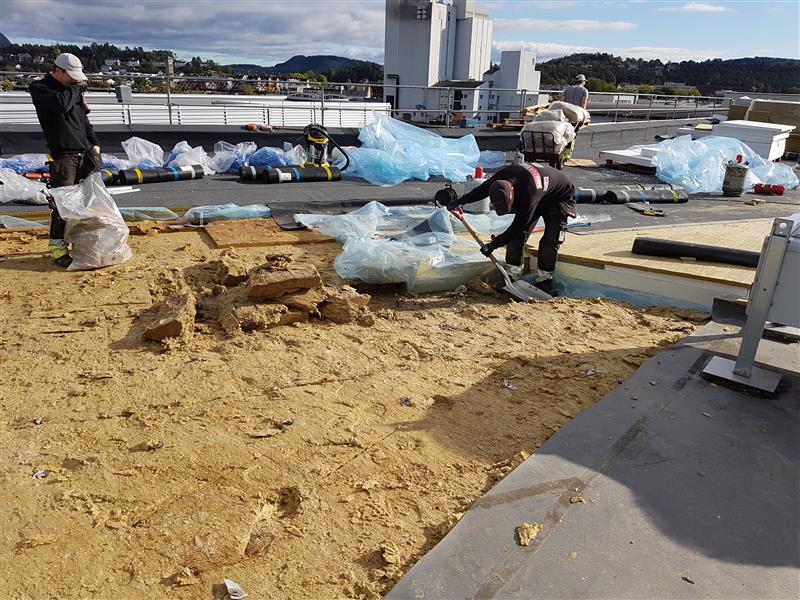
Moisture damage often occurs in roofs that have been exposed to weather, temperature fluctuations, and varying moisture levels over time. What fewer people consider is that the environmental impact of damage can vary dramatically. According to research from the Klima2050 project, presented by SINTEF and NTNU, emissions related to roof leaks in residential buildings can range from approximately 36 kg CO₂ equivalents to more than 3,300 kg [1].

David Bjelland points out that these large variations are primarily related to the extent of the leak, how quickly it is detected, and the complexity of the damage. The later a leak is discovered, the greater the risk of extensive repairs, material replacement, and increased energy use for drying.
Monitoring enables early alerts and reduces emissions
“Traditionally, moisture damage is first detected when water has penetrated visible surfaces,” explains Bjelland. “But with moisture sensors that continuously monitor the roof structure, alerts are triggered before the damage has had time to develop.”
By detecting deviations early, corrective measures can be implemented quickly whether the issue is a leak, condensation, or other moisture exposure. This reduces the need to replace materials, avoids large-scale drying operations, and consequently lowers material use and emissions.
From design to operation – a holistic approach to moisture safety
Moisture safety should not be limited to the design phase of a construction project, it should be an integrated part of the entire building lifecycle. Bjelland emphasizes that while quality during design and construction is important, preventing damage during the in the operational phase is just as critical.
By installing sensors, building owners gain continuous insight into the condition of the roof, serving as a form of quality assurance during the operational phase.
Extreme Weather event Increases the Need for Early Warning
During weather events that put very high stress on roof structures, early detection makes a significant difference. Bjelland explains that during severe weather events such as storms “Hans” and “Amy,” sensors were used to detect deviations within a short time frame, enabling rapid response and damage limitation. Such technology provides better control in situations where the risk of leaks and damage is high.

By documenting how moisture conditions change over time, stakeholders also gain an additional insight into building operation, ownership transfer, or insurance matters.
Sustainable buildings also means avoiding damage
When large amounts of materials must be replaced, both costs and environmental impact increase through energy needed for drying or extensive repairs. Bjelland emphasizes that monitoring with low–climate-footprint technology is not only about operational reliability, it is a climate measure in practice. Knowing exactly where and when action is needed, enables more efficient planning, avoids unnecessary replacements, and reduces both waste and emissions.
The sensor technology also provides valuable data for future initiatives. When, installing solar panels or carrying out technical upgrades, building owners have a clear overview of the roof’s condition before work begins and can continue monitoring developments afterward.


Summary
Moisture damage is not only a building-technical issue—it is also an environmental challenge. By installing moisture sensors and implementing continuous monitoring, the focus can shift from repair to prevention. This results in reduced damage extent, lower material use, fewer emissions, and ultimately longer service life for affected materials.
David Bjelland summarizes: When we take this seriously, we are not just building for today we are building for the future.
Referanse
[1] Moschetti et al. 2025, Når regnet slipper inn, går utslippene opp - SINTEF, Andenæs et al. 2020, Footprints of failure: Quantifying carbon impacts of roof leakages in a single-family residential building - IOPscience
Want to learn more?
Feel free to contact us to learn how our solutions can be integrated into your building or project—and help increase safety, reduce risk, and lower environmental impact.